Part I: Theoretical & Biomechanical Foundations
Book Title: The Ground-First Golf Blueprint: Precision Setup Geometry, Progressive Offset & Dynamic Flow
Volume / Section: Part I — Theoretical & Biomechanical Foundations
Target Clubs: Callaway Apex Ai300 Irons (4i–PW) • PING Fairways (7W / 9W) • PING G440 Max Driver (10.5°)
Cross-References: book_index.md • part_2_11_step_core_routine.md • part_3_iron_grip_and_striking.md
Executive Overview: The Core Physics of Pure Ball Striking
A consistent, repeatable golf swing is built on fundamental geometric laws and biomechanical principles. Modern high-technology golf equipment—engineered with progressive hosel offsets, perimeter weighting, variable lie angles, and ultralight shafts—delivers unmatched forgiveness and ball speed. However, without precise setup geometry calibrated directly to the ground, these same engineering features produce catastrophic optical illusions that compromise dynamic execution.
Part I breaks down the biomechanical disconnect between the practice range and the golf course, the physics of low-point control, and the exact equipment specifications required for the full bag.
Chapter 1: The "Range-to-Course" Disconnect & Cognitive Illusion
1.1 Artificial Range Alignment vs. Open Turf Parallax
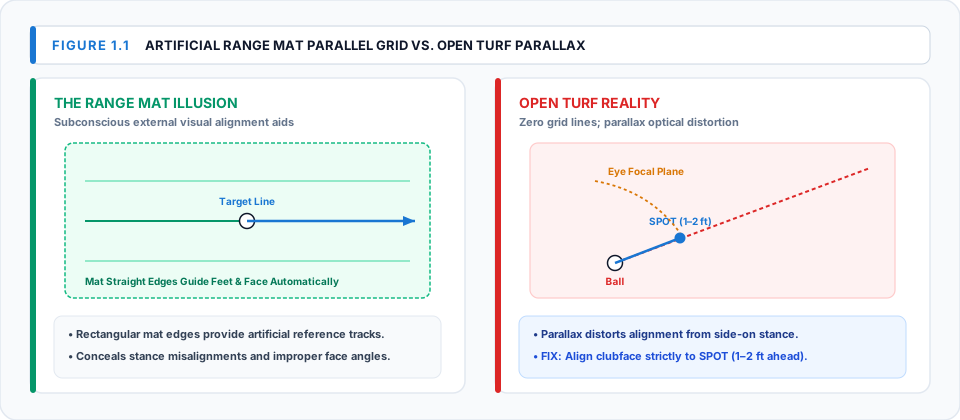
Driving range mats and synthetic practice bays provide artificial parallel visual cues: straight mat edges, rectangular borders, and alignment channels. These external grids give the golfer subconscious visual reference lines that mask setup misalignments.
When transitioning to open turf:
- There are no artificial boundary lines.
- The visual system must rely strictly on the relationship between the clubface, the target line, and body alignment.
- Without ground calibration, optical parallax distorts perception.
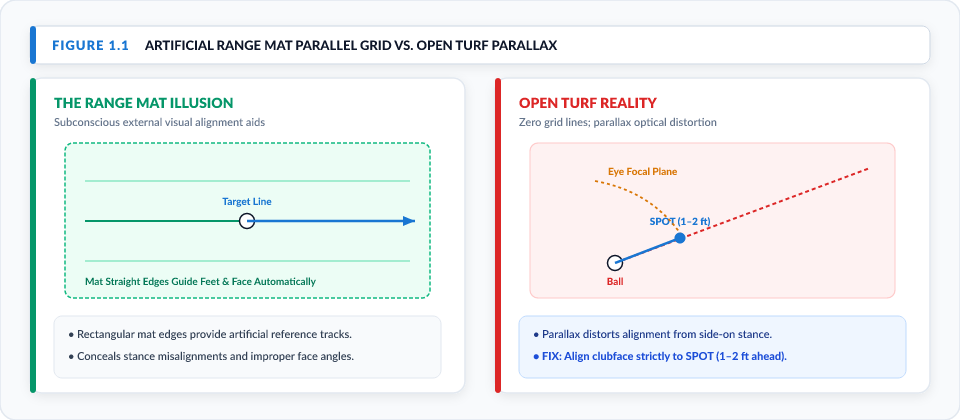
Figure 1.1: Artificial Range Mat Grid vs. Open Turf Parallax. View Vector SVG
1.2 The Visual Offset Illusion in Modern Irons
Modern player-distance and game-improvement irons (such as the Callaway Apex Ai300) feature engineered progressive offset—where the leading edge of the clubface sits set back relative to the hosel centerline:
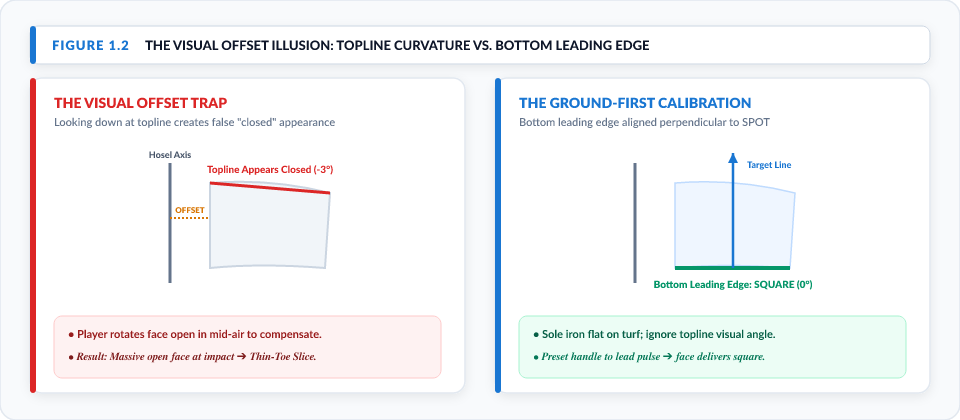
Figure 1.2: The Progressive Offset Visual Illusion: Topline Curvature vs. Bottom Leading Edge. View Vector SVG
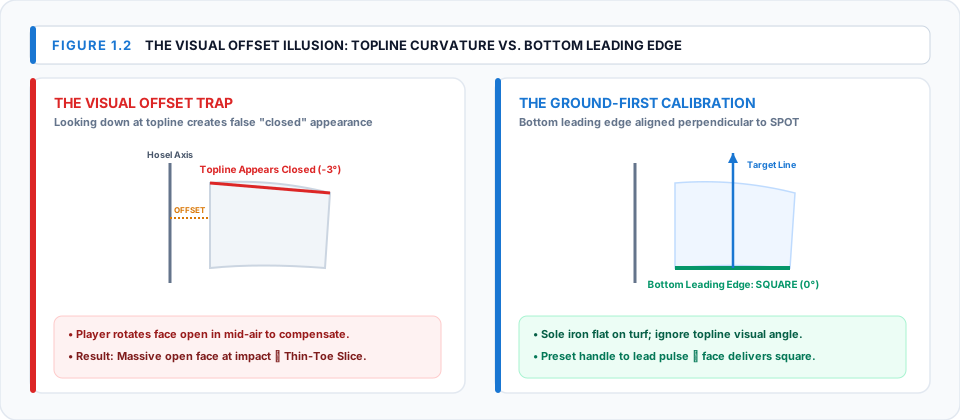
- The Optical Illusion: Looking down from an address posture on open turf, progressive offset causes the clubface topline to appear angled to the left (closed relative to the target line).
- The Subconscious Reaction: The brain instinctively perceives a "closed face" and attempts to correct it at address by:
- Leaning the shaft backward (away from the target).
- Rotating the hands outward to open the face.
- Weakening the lead hand grip (placing the palm under the shaft).
1.3 The Destructive Subconscious Cascade
When the golfer backs the handle up to make the topline look square:
- Loss of Forward Shaft Lean: The designed $3^\circ\text{–}6^\circ$ forward lean is completely neutralized.
- Effective Bounce Reduction: The club's bounce geometry is compromised, making the leading edge prone to digging into turf or bouncing erratically.
- Low-Point Retreat: The low point of the swing arc shifts behind the golf ball.
- Arm Retraction ("T-Rex Arms"): To avoid digging into the turf before the ball, the player subconsciously pulls the lead elbow inward and cups the lead wrist through impact.
Chapter 2: Ball Flight Dynamics & The Dual Miss Mechanism
2.1 The Biomechanics of the "Thin-Toe Slice"
When the low point retreats behind the ball due to backed-up handle geometry, the club reaches its lowest point before impact and is already ascending when it strikes the ball:
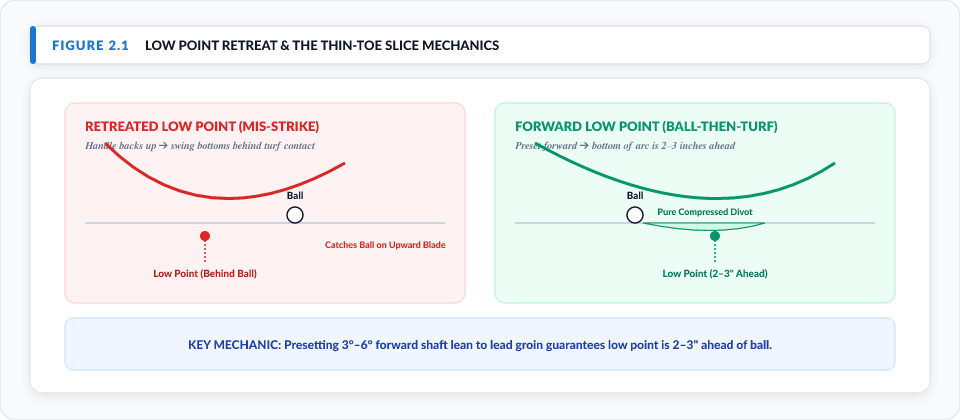
Figure 2.1: Low Point Retreat & The Thin-Toe Slice Mechanics. View Vector SVG
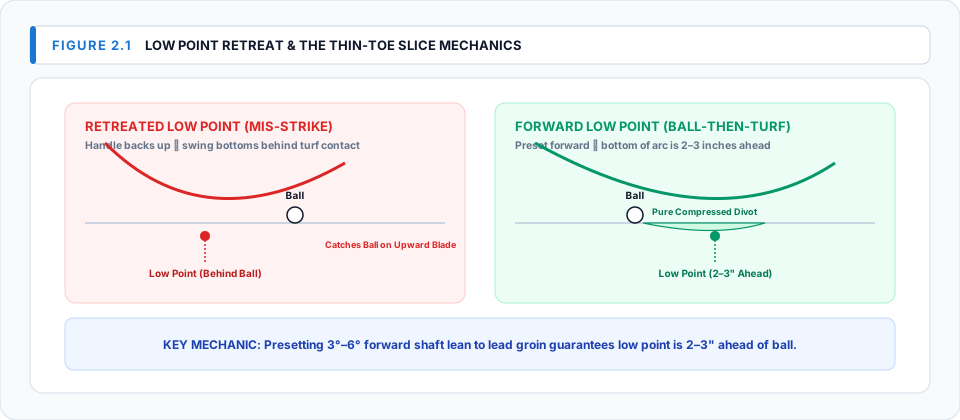
- Strike Point: High on the toe section of the face.
- Face Angle: Wide open dynamic face angle relative to the out-to-in swing path.
- Flight Outcome: Weak, spinning slice with low compression, high launch, and severe distance loss.
2.2 The Physics of the "Out-to-In Dual Miss" (Woods & Driver)
When a golfer struggles with an out-to-in swing path (cutting across the ball from outside-in), they almost always experience a perplexing "dual miss" with Fairway Woods (7W/9W) and Driver:
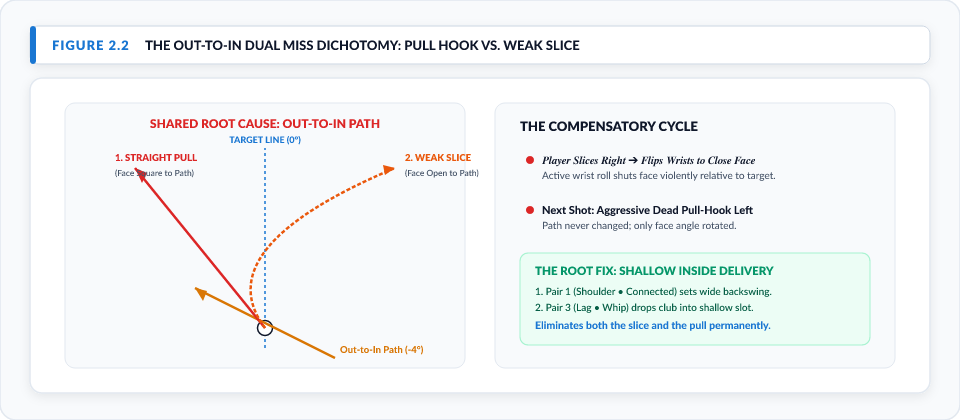
Figure 2.2: The Out-to-In Dual Miss Dichotomy: Pull Hook vs. Weak Slice. View Vector SVG
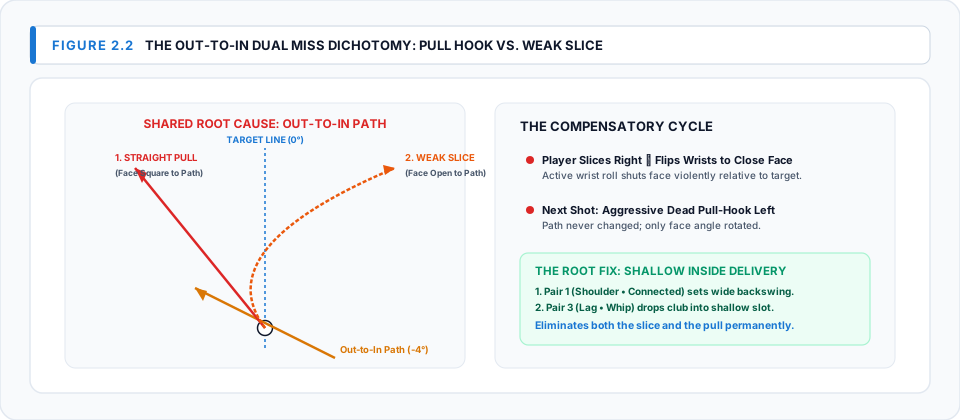
- The Slice / Fade: The path moves left, but the player fails to close the face to the path; ball starts slightly left and slices aggressively to the right.
- The Straight Pull: The path moves left, and the player subconsciously snaps the wrists shut; the face delivers square to the leftward path, rocketing dead straight left into trouble.
Core Realization: Both misses stem from the exact same out-to-in swing path. Attempting to fix the slice by "rolling the hands shut" simply converts the slice into a catastrophic straight pull. The true solution is establishing ground-first setup geometry and swinging from the inside slot.
2.3 Low-Point Control & Divot Geometry
For iron play, pure ball striking requires striking the ball on the downward portion of the swing arc, creating a divot that starts directly underneath the front edge of the ball and extends 2 to 4 inches forward.
$$\mathbf{\text{Forward Low Point (FLPO)} = \text{Lead Weight Bias (60%)} + \text{Forward Shaft Lean } (3^\circ\text{–}6^\circ) + \text{Gaze Lock (Front Hemisphere)}}$$
2.4 The Physics of "Lag & Whip": Double-Pendulum Acceleration vs. Hand Pushing
The human golf swing operates mechanically as a double pendulum:
- Primary Pendulum: The rotation of the shoulders and torso around the spine axis.
- Secondary Pendulum: The arms, wrists, and club shaft pivoting around the wrists.
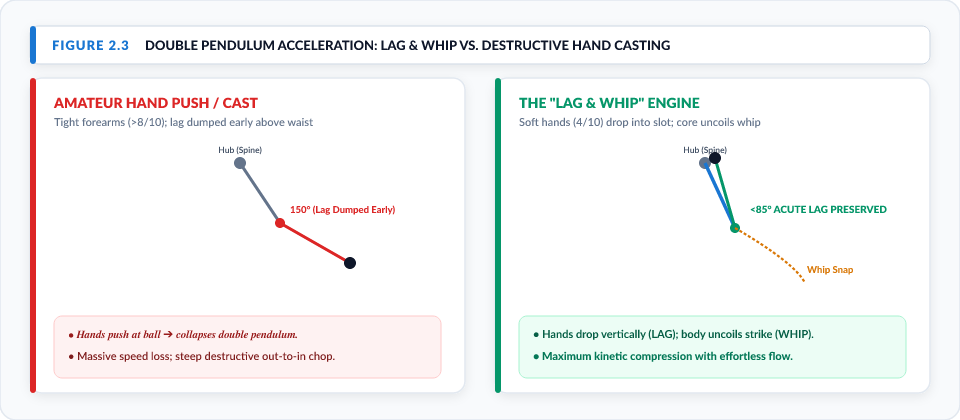
Figure 2.3: Double Pendulum Acceleration: Lag & Whip vs. Destructive Hand Casting. View Vector SVG
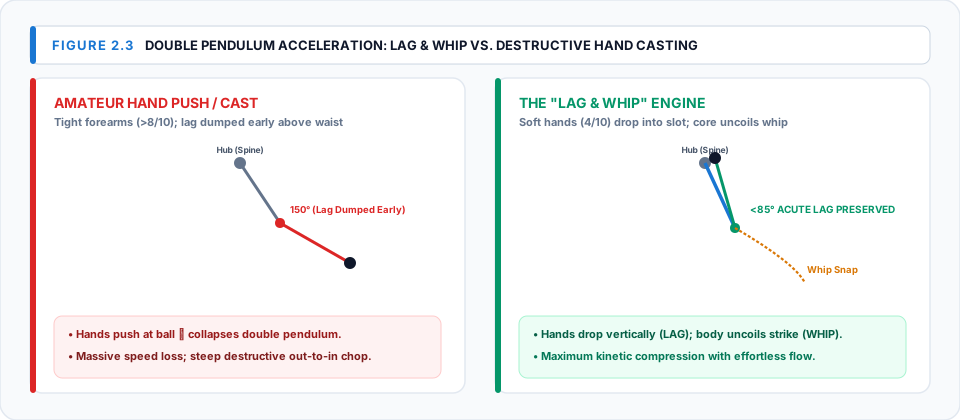
- Why Pushing with the Hands Fails:
- Muscular tension in the forearms locks the wrist joint, turning the double pendulum into a single, slow, rigid lever.
- Pushing from the top immediately un-hinges the wrists (casting), dumping angular momentum before the hands reach hip height.
- Why "Lag & Whip" Generates Maximum Speed & Compression:
LAG(The Soft Drop): By keeping grip pressure at 4/10 and allowing gravity to drop the hands vertically into the inside slot, the acute angle between forearm and shaft ($<90^\circ$) is fully preserved deep into the downswing.WHIP(The Rotational Snap): As the lower body and chest rotate open toward the target, the stored elastic lag is released through impact with explosive centrifugal velocity (the whip effect).
Chapter 3: Equipment Geometry & Hosel Optimization
3.1 Lie Angle Influence Across Lofts ($2^\circ$ Flat Specification)
The lie angle of a golf club dictates the tilt of the face plane in 3D space. The higher the club's static loft, the more severely an incorrect lie angle steers the initial ball launch:
$$\text{Horizontal Face Deviation} \approx \sin(\text{Loft Angle}) \times \sin(\text{Lie Angle Error})$$
| Club Type | Static Loft | $2^\circ$ Upright Error Consequence | $2^\circ$ Flat (Apex Ai300 Spec) Rationale |
|---|---|---|---|
| Short Irons / Wedges | $36^\circ\text{–}46^\circ$ | Face tilts sharply left $\rightarrow$ violent pull-hooks | Neutralizes heel-digging; matches natural arm hang for laser-straight launch. |
| Mid Irons (6i–7i) | $26^\circ\text{–}30^\circ$ | Moderate leftward launch bias | Centers turf strike across the sole width. |
| Long Irons (4i–5i) | $20^\circ\text{–}23^\circ$ | Mild leftward tilt; heel drags in turf | Prevents premature heel contact on shallow strikes. |
- The $2^\circ$ Flat (Orange Dot equivalent) specification aligns the Ai300 iron sole flush with the ground at dynamic impact, completely eliminating heel-dig pulls.
3.2 PING Fairway Woods (7W & 9W) — Setting: Flat $+1^\circ$
Factory PING fairway wood lie angles are engineered relatively upright ($58.5^\circ\text{–}59.5^\circ$). When swung by a player with standard arm hang, the upright lie causes the heel to strike the turf prematurely, twisting the face open and causing high, weak slices.
The Flat $+1^\circ$ Hosel Solution:
- Flatter Lie Angle: Matches natural spine tilt and address posture, ensuring the wide sole glides flat across the turf without catching.
- Added Static Loft ($+1^\circ$): Increases 7W loft to $\approx 22^\circ$ and 9W to $\approx 25^\circ$.
- Face Angle Neutralization: Adding $+1^\circ$ loft via the adjustable hosel sleeve rotates the clubface slightly closed at address. This mechanically cancels the open-face slice bias without requiring active hand rolling.
3.3 PING Driver (10.5° G440 Max) — Setting: Flat 0
Setting the driver hosel to Flat 0 ($1^\circ$ flatter lie angle with standard $10.5^\circ$ loft) aligns the driver geometry with the player's natural arm hang and flatter iron setup ($2^\circ$ Flat):
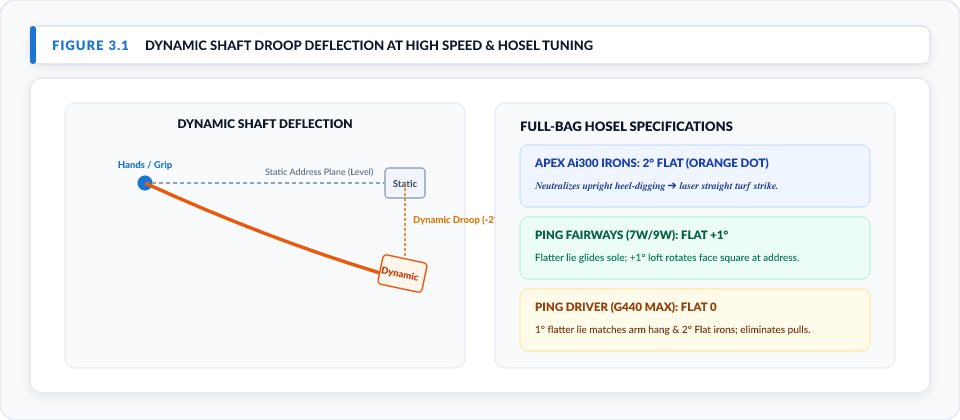
Figure 3.1: Dynamic Shaft Droop Deflection at High Speed & Equipment Hosel Solutions. View Vector SVG
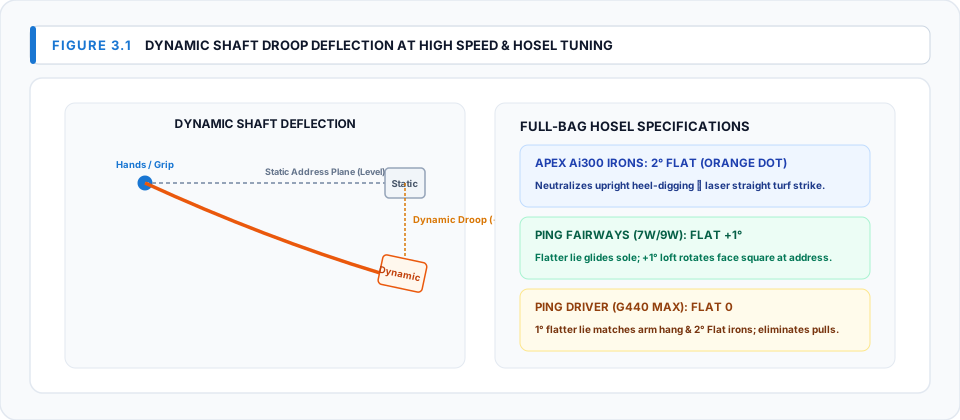
- The Lie Angle Match: A flatter lie angle ($57.5^\circ$) sits the sole flush behind the ball, eliminating heel-down dragging and pull-hooks.
- Level Center Delivery: Works harmoniously with the Tilt & Set address posture, delivering the sweet spot square and level to the horizon for maximum ball speed and low spin.
Chapter Summary Checklist: Part I Mechanical Rules
- Rule 1: Never judge face angle by looking down in mid-air. Ground the sole on the turf first.
- Rule 2: Progressive offset requires presetting $3^\circ\text{–}6^\circ$ forward shaft lean to lead femoral pulse.
- Rule 3: Slices and straight pulls share the same out-to-in path; fix the inside slot delivery rather than snapping the wrists.
- Rule 4: Initiate takeaway with Pair 1: SHOULDER • CONNECTED; feel the lead shoulder push down into the trail heel to anchor ground pressure with passive hands.
- Rule 5: Supinate/hinge trail wrist into the "Waiter's Tray" at the top (Pair 2: WRIST • SLOW) to lock the lead wrist flat and store lag.
- Rule 6: Never push with the hands. Execute Pair 3: LAG • WHIP (hands drop soft $\rightarrow$ body uncoils the strike).
- Rule 7: Maintain equipment tuning: $2^\circ$ Flat irons, Fairways at Flat $+1^\circ$, Driver at Flat 0.